- 2025
- Spain
- Magnetic Fields 1
- Epica Oxygene
- Oxymore
- Sex in the machine
- Oxygene 2
- Arpeggiateur
- Zoolookologie
- Equinoxe 7
- The Architect
- Zero Gravity (Above and beyond remix)
- Exit
- Industrial Revolution 2
- Robots don’t cry
- Herbalizer
- Oxygene 19
- Equinoxe 4
- Brutalism
- Oxygene 4 Astral Projection Remix
- Epica
- Stardust
- Rendez-Vous 4
- Magnetic Fields 2
When a renowned artist reaches a certain age, there are only three things they can do. The most definitive is to die (Vangelis, 1943-2022). The most logical is to retire to an island in the Bahamas to enjoy the sea and the royalties (Mike Oldfield, silent since 2018). The most commendable is to keep working. And this last one is the one chosen by Jean-Michel Jarre, who embarked in 2025 on a new tour called the Special Summer Live Tour, which in just over a month has taken him to Oslo, Helsinki, Tallinn, Slutsk, Sofia, Budapest, Pula, Brussels, Venice, Pompeii, Seville, and Stuttgart.
The Frenchman has made a very accurate analysis of the current zeitgeist, even if he drew the wrong conclusions. The album-concert-two-year silence-start-up cycle no longer makes sense in a music scene driven by algorithms that need constant feeding. To avoid becoming irrelevant, Jarre has gone from releasing a studio album every three years to publishing Electronica 1 in 2015, Electronica 2 and Oxygène 3 in 2016, Planet Jarre and Equinoxe Infinity in 2018, EON in 2019, Welcome to the Other Side and Amazônia in 2021, Oxymore in 2022, Oxymoreworks in 2023, and Versailles 400 in 2024. This breakneck pace could be behind some notable blunders in the remastering of some of his classic works, such as the ’40th Anniversary’ version of Zoolook, also released in 2024. Furthermore, he has significantly increased his presence on social media. And his concerts are no longer the massive events that bring cities to a standstill.
The concert held in Seville on July 8th was doubly framed, on the one hand in this quasi-permanent tour of public exposure by Jarre and on the other in the Icónica festival of the Andalusian capital, which gave the Frenchman the opportunity to add the Plaza de España to the list of prominent places where he has performed.
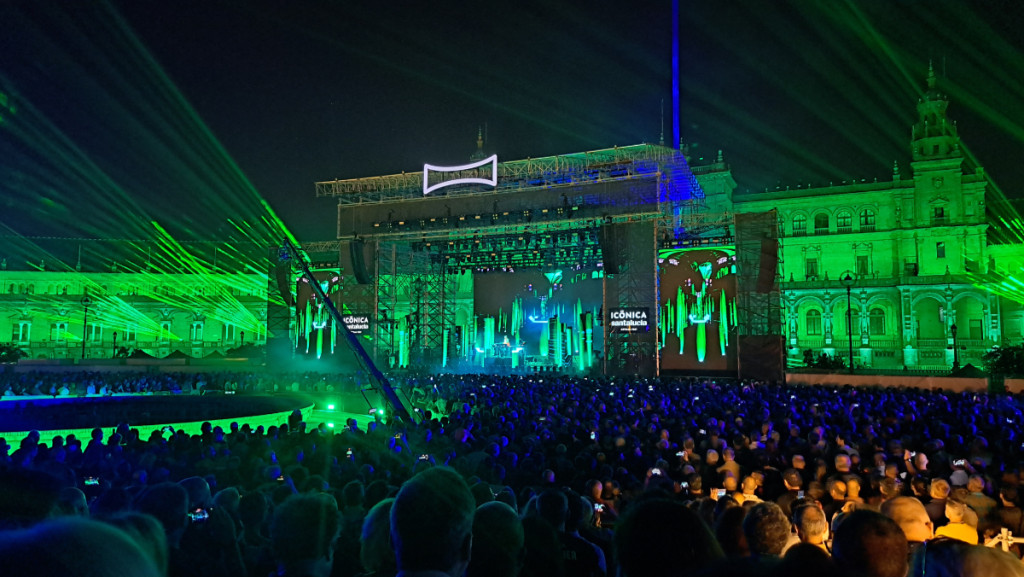
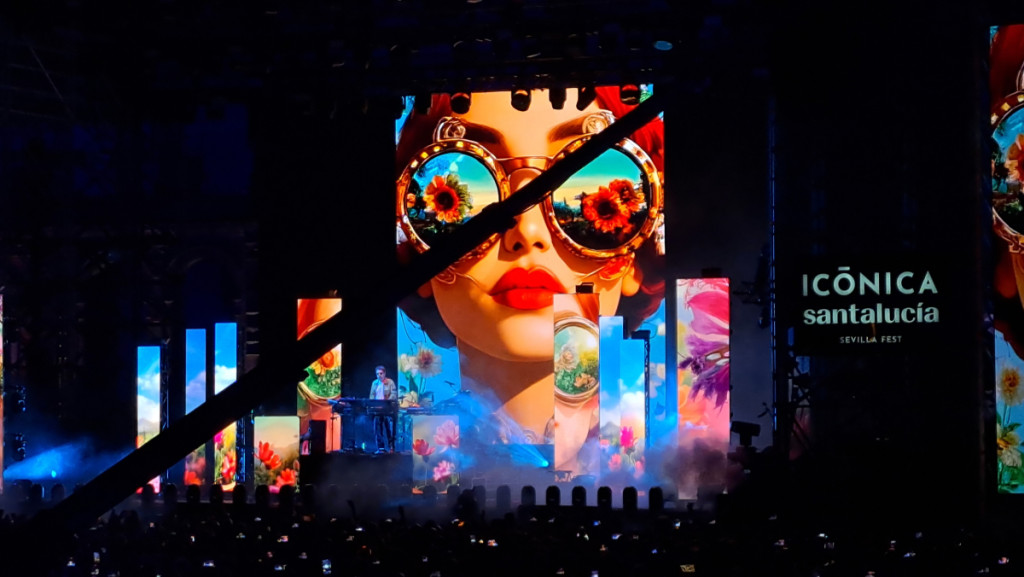
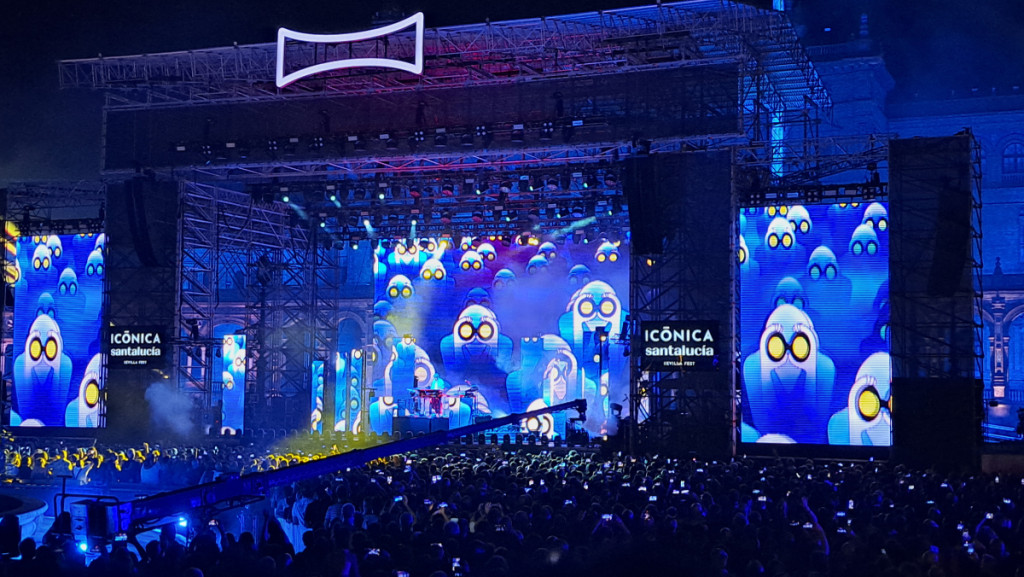
Given the tour’s brevity and limited number of performances, it’s understandable that the stage production couldn’t be as elaborate as his more historic concerts. However, it was no less spectacular: lights, lasers, and 3D screens were all present. The visual spectacle not only remained undiminished but also incorporated the latest advancements in stage design. As ever a lover of technology, Jarre embraced the allure of artificial intelligence, using AI-generated visuals to accompany his songs.
However, one detail did upset fans: the lack of other musicians on stage. For over a decade, the lineup of musicians accompanying Jarre has been shrinking, and this time he performed alone, further reinforcing a less than edifying drift towards the standard DJ concept and definitively losing that distinctive feature that made his concerts a unique way of bringing electronic music to the public.
But it’s musically where Jarre’s decisions are most debatable. Having reached a certain age, and having opted for the difficult choice of continuing to work, the next dilemma every musician faces is whether to stick with their style to maintain their fanbase or embrace change to attract new fans. And in recent years, Jarre has tried to play it safe. On the one hand, albums like Oxygène 3 and Equinoxe Infinity, as well as the remasters of Zoolook and The Concerts in China, clearly aimed to satisfy the mature fan; on the other, remix albums like OxymoreWorks or live albums like Welcome to the Other Side, with their prominent dance character, sought to attract a new, younger audience, or one more interested in the less contemplative side of electronic music.
At the Plaza de España concert, Jarre tries to do the same, without realizing that the younger audience, or the audience more interested in electronic dance music, is simply not in the square.
He opened the setlist with a version of ‘Magnetic Fields 1’, boosted to a higher BPM and featuring a pounding bassline that didn’t bode well. However, the initial high plummeted to the lowest point with the next three tracks, taken from his latest album, Oxymore. It’s one of the most interesting works the Frenchman has released in recent years and certainly has great potential for a live performance, but a concert of this scale and nature isn’t one of them. Adding techno beats to tracks like ‘Epica’, ‘Oxymore’, and ‘Sex in the Machine’ only serves to saturate them and cause them to lose all their sonic nuances and details.
The momentum was regained quickly, thankfully. After a long but interesting introduction of pure ambient music, the recognizable chords of ‘Oxygène 2’ began, followed by the big surprise of the night: ‘Arpegiateur’, a piece that hasn’t appeared in any of Jarre’s live performances since 1982. The following ‘Zoolookologie’ and ‘Equinoxe 7’ formed a kind of medley to balance the journey between classic tracks and new compositions.
The techno euphoria returned with ‘The Architect’, ‘Zero Gravity’ and ‘Exit’, was briefly interrupted with a truly epic rendition of ‘Industrial Revolution part 2’ and returned with remixed versions of ‘Equinoxe 4’, ‘Brutalism’, ‘Oxygene 4’ or ‘Stardust’.
Jarre is a seasoned performer and knows how to close a concert. The shortened versions of ‘Rendez-Vous 4’ and ‘Magnetic Fields 2’ may have left everyone in attendance with a positive impression. But they also revealed, upon closer examination, that the concert lacked any internal narrative: it was a succession of tracks with very high peaks of enthusiasm interspersed with techno-travels bordering on apathy. And anyone who reviews the recording of the event can confirm which moments belong to which category.
Musically, the delicate balance the Frenchman tries to maintain between his classic and contemporary music faltered at the Seville concert. Considered a complete audiovisual spectacle, there is perhaps no other musician in the world with Jean-Michel Jarre’s ability to transform an urban setting into a communion of architecture, technology, and emotion.